Update: Automatic server-side drop shadows were reverted because that regressed the visuals of a reasonable number of apps. It appears like applications use normal toplevel windows to implement popups instead of relying on more appropriate window types. The window rule is still there. We’d like to revisit automatic SSD drop shadows, but at the moment, it’s on the back burner.
It’s been a long time since I wrote here last time. I would like to share a few details about a feature that I’m really excited about, which landed in KWin recently.
Drop shadows are drawn either by the compositor or the application. For example, a good chunk of GTK applications employ the latter strategy, the drop shadows are drawn on the client side; Qt applications usually ask the compositor to draw a window decoration plus the drop shadow. However, there are also applications that do neither. For the consistency sake, it will be nice if you could force the compositor to add drop shadows for those windows. This is the new feature that will come in the next release of Plasma — 6.8.
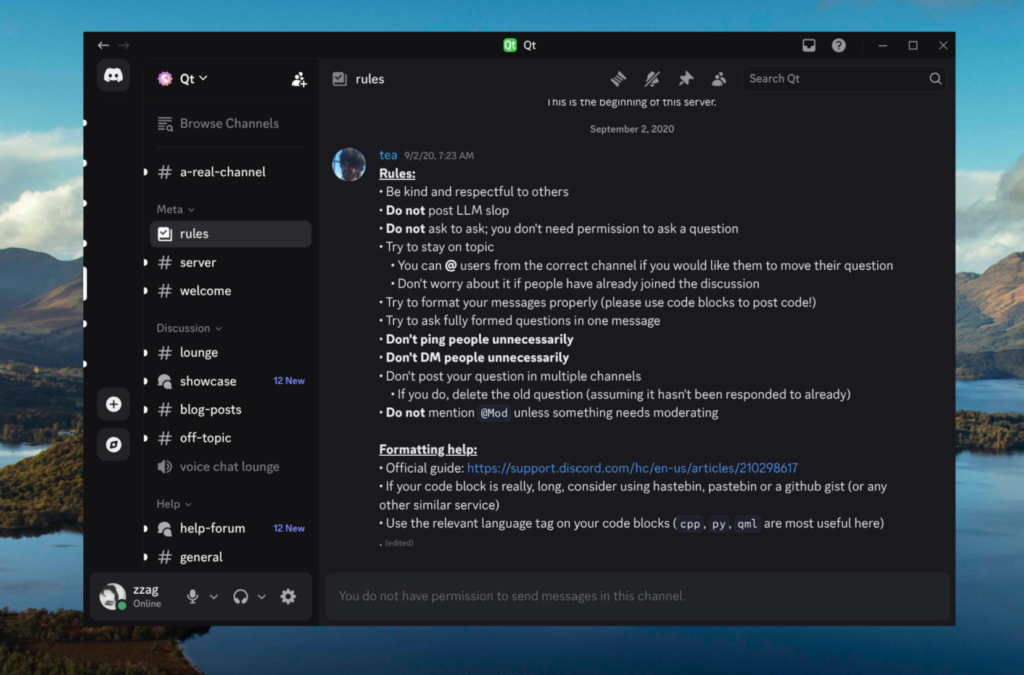
For example, consider Discord with the current defaults
It has square corners, there are no drop shadows, the titlebar buttons don’t look consistent, etc.
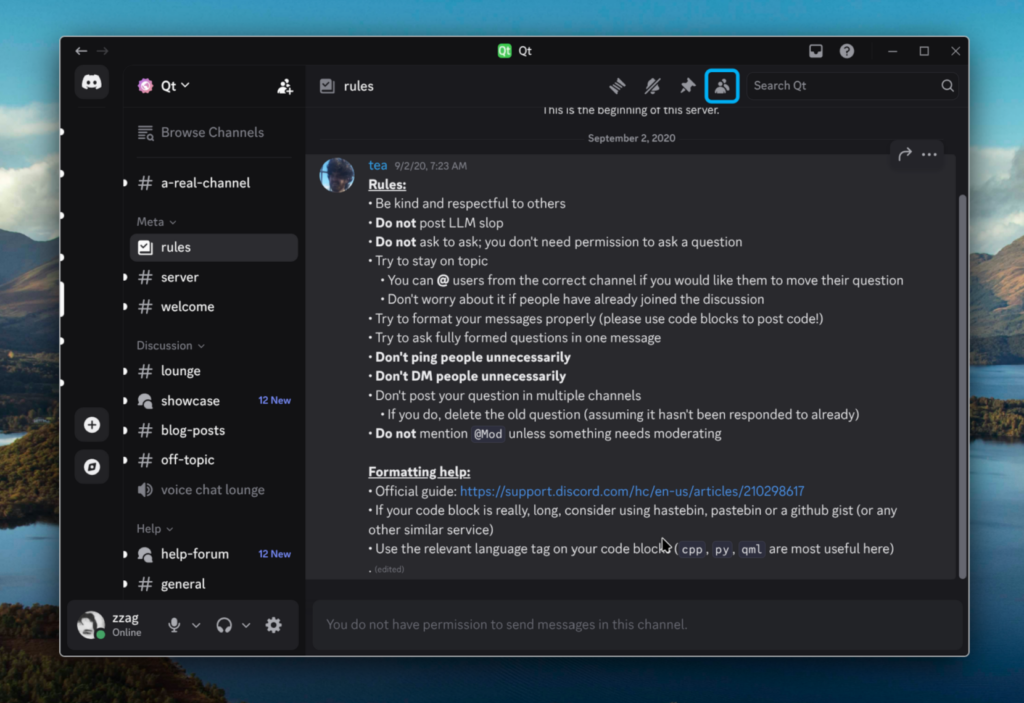
With the new changes, Discord will look as follows
There are still some inconsistency issues, e.g. the close, maximize and minimize buttons don’t look consistent, but still, now, Discord blends in better with the rest of Plasma, for example it casts a shadow, it has rounded corners and there is an outline drawn around the window.
How it works
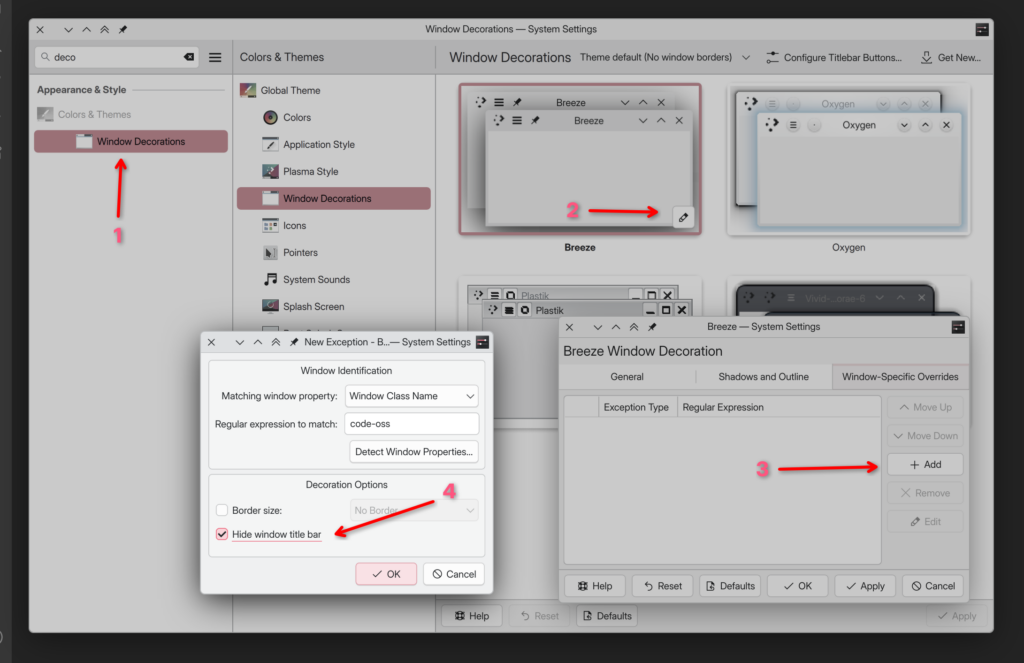
You can already achieve similar visuals in 6.7. In order to do that, you need to create a window rule to force a server-side decoration, and then go to Breeze decoration settings and create a window-specific override to hide the titlebar.
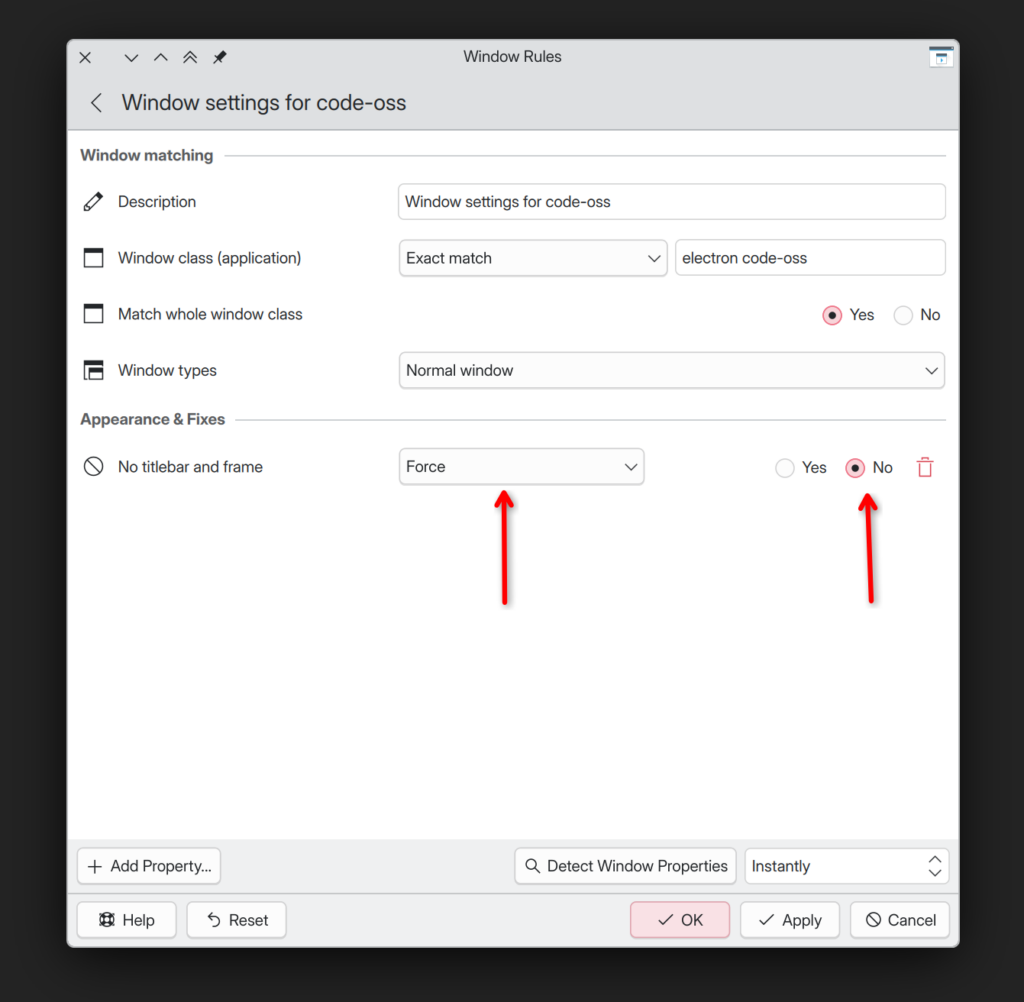
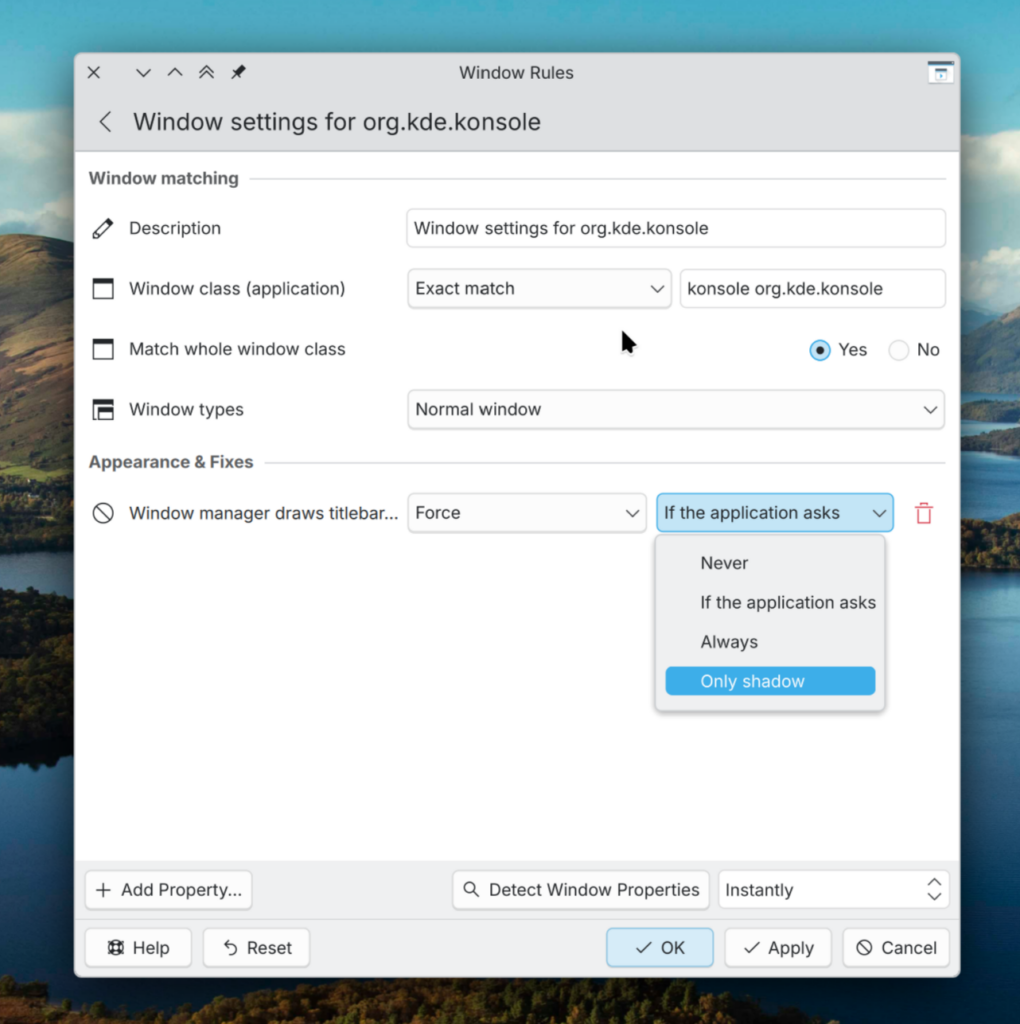
For example, here are the required steps to add a server-side drop shadow around Visual Studio Code in Plasma 6.7
“No titlebar and frame” window rule
Breeze window-specific overrides
The changes in 6.8 rather automate those steps for you. Unfortunately, it doesn’t work with every available decoration in the wild. Decorations need to opt-in to providing only server-side drop shadows.
First, a decoration needs to declare that it supports both shadow-only and titled decorations in the metadata, e.g.
Then the decoration needs to adjust its visuals based on the value of KDecoration3::Decoration::style(). For example, hide the titlebar, etc.
How to add shadows around windows
If you would like a given window to have a server-side drop shadow, we added a new “Window manager draws titlebar, frame, and shadows” window rule that supersedes the old “No titlebar and frame” rule
Note that KWin will automatically add drop shadows to X11 windows that have neither a server-side decoration nor a client-side drop shadow. No such a thing will be done for Wayland windows though because of sub-surfaces. On Wayland, we may need a protocol to opt-in to such things, in meanwhile, you’ll need to use window rules.
Closing words
Anyway, it’s a rather quick development update. This is a small thing but I hope that people will find it useful for making their desktops look more eye-candy.
Global objects are one of the core abstractions in Wayland. They are used to announce supported protocols or announce semi-transient objects, for example available outputs. The compositor can add and remove global objects on the fly. For example, an output global object can be created when a new monitor becomes available, and be removed when the corresponding monitor gets disconnected.
While there are no issues with announcing new global objects, the global removal is a racy process and if things go bad, your application will crash. Application crashes due to output removal were and still are fairly common, unfortunately.
The race
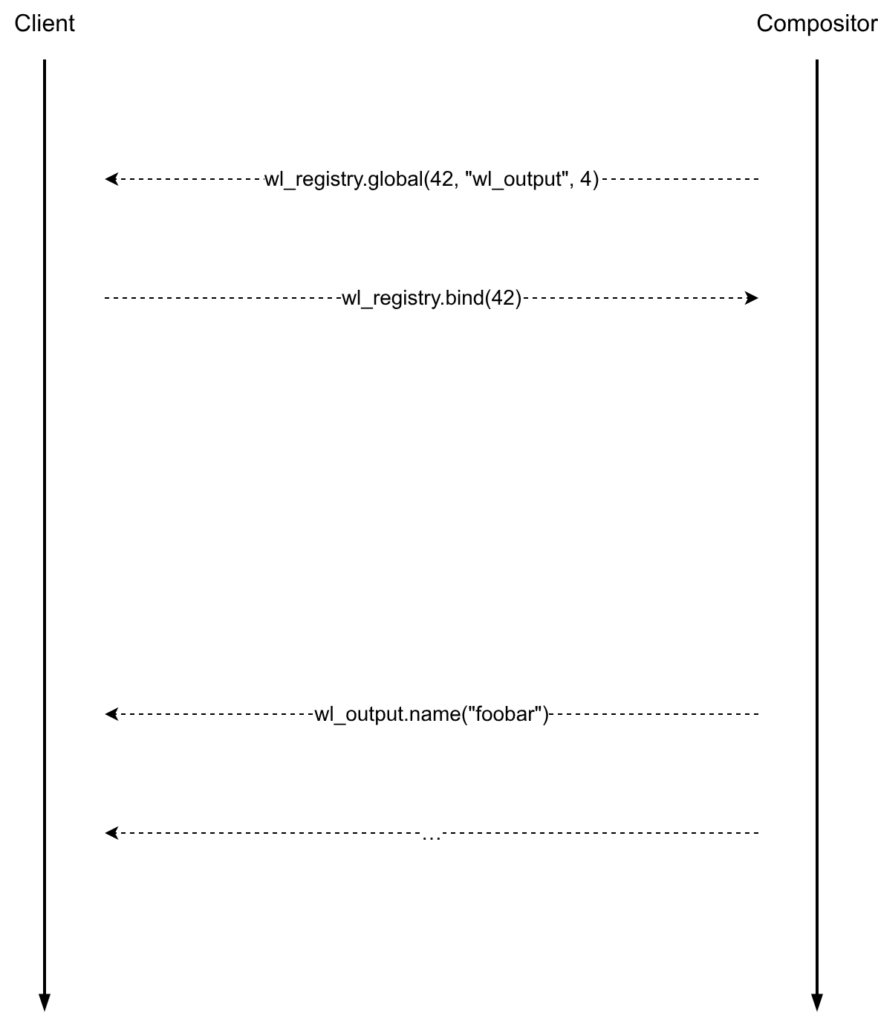
Let’s start from the start. If the compositor detects a new output, it may announce the corresponding wl_output global object. A client interested in outputs will then eventually bind it and receive the information about the output, e.g. the name, geometry, and so on:
A new wl_output announcement.
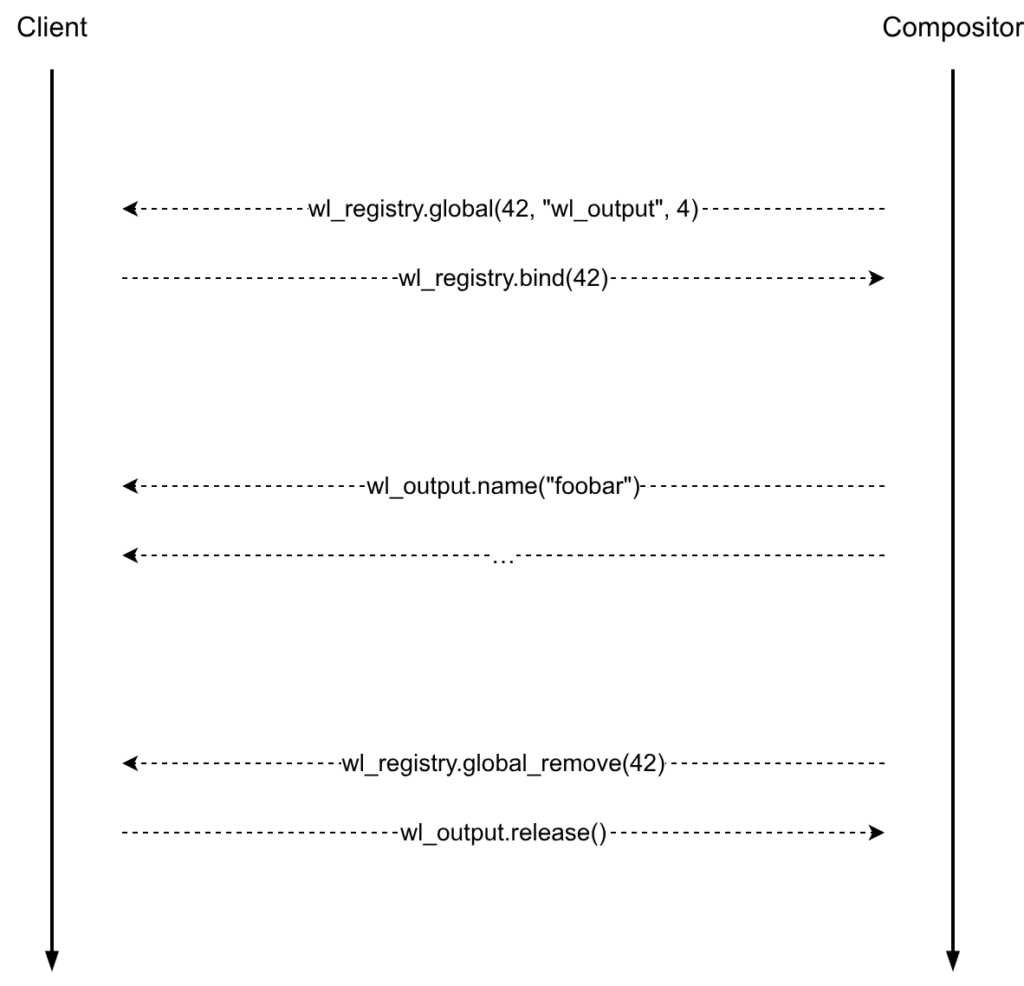
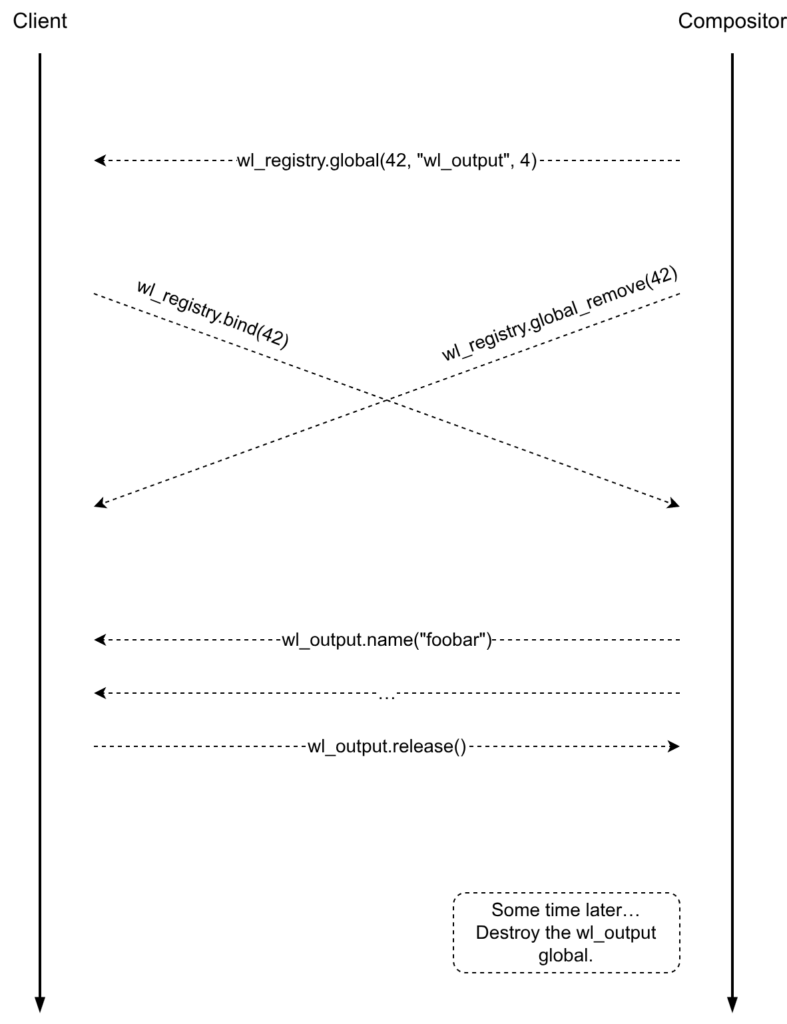
Things get interesting when it is time to remove the wl_output global. Ideally, after telling clients that the given global has been removed, nobody should use or bind it. If a client has bound the wl_output global object, it should only perform cleanup.
The preferred way to handle wl_output global removal.
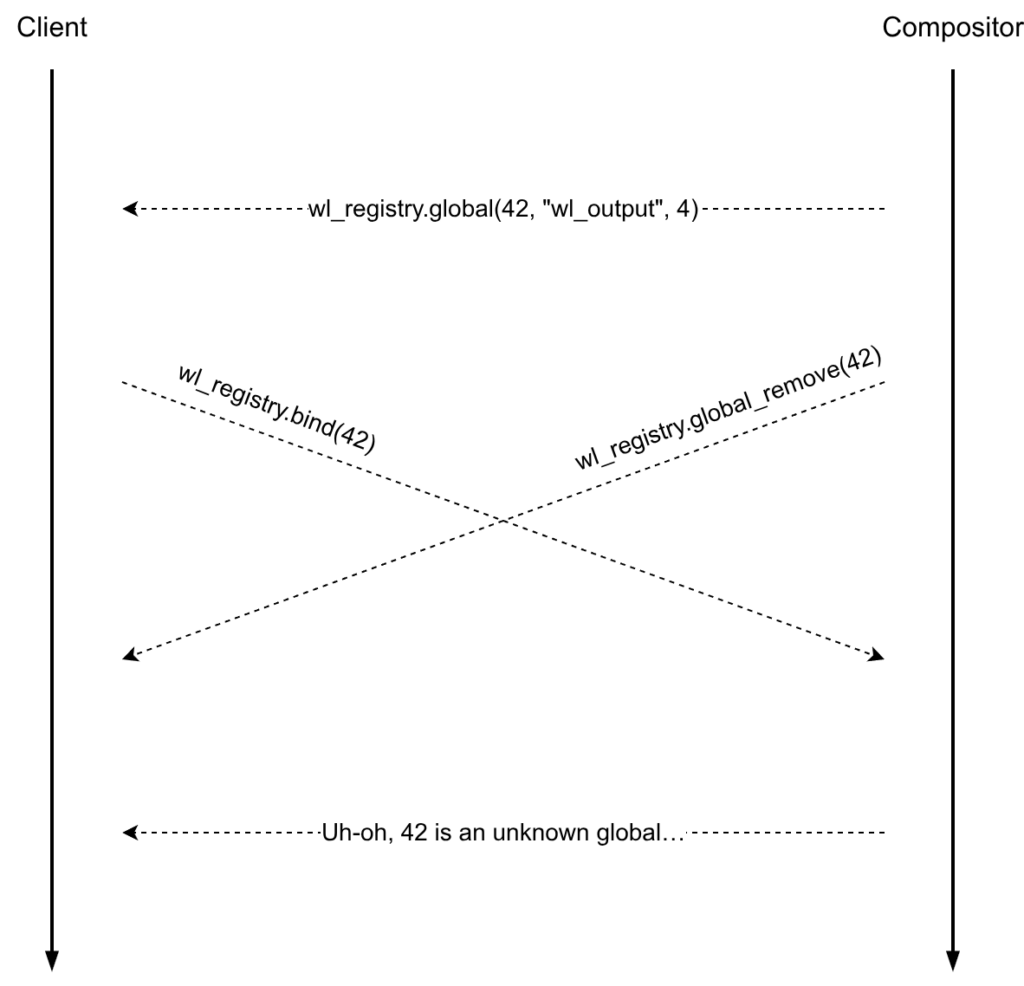
However, it can happen that a wl_output global is removed shortly after it has been announced. If a client attempts to bind that wl_output at the same time, there is a big problem now. When the bind request finally arrives at the compositor side, the global won’t exist anymore and the only option left will be to post a protocol error and effectively crash the client.
A wl_output global removal race.
Attempt #1
Unfortunately, there is not a lot that can be done about the in-flight bind requests, they have to be handled. If we could only tell the clients that a given global has been removed but not destroy it yet, that would help with the race, we would still be able to process bind requests. Once the compositor knows that nobody will bind the global anymore, only then it can destroy it for good. This is the idea behind the first attempt to fix the race.
The hardest part is figuring out when a global can be actually destroyed. The best option would be if the clients acknowledged the global removal. After the compositor receives acks from all clients, it can finally destroy the global. But here’s the problem, the wl_registry is frozen, no new requests or events can be added to it. So, as a way around, practically all compositors chose to destroy removed global objects on a timer.
That did help with the race, we saw a reduction in the number of crashes, but they didn’t go away completely… On Linux, the monotonic clock can advance while the computer sleeps. After the computer wakes up from sleep, the global destruction timer will likely time out and the global will be destroyed. This is a huge issue. There can still be clients that saw the global and want to bind it but they were not able to flush their requests on time because the computer went to sleep, etc. So we are kind of back to square one.
Attempt #2
The general idea behind the first attempt was sound, the compositor only needs to know the right time when it is okay to finally destroy the global. It’s absolutely crucial that the Wayland clients can acknowledge the global object removal. But what about the wl_registry interface being frozen? Well, it’s still true, however we’ve got a new way around — the wl_fixes interface. The wl_fixes interface was added to work around the fact that the wl_registry interface is frozen.
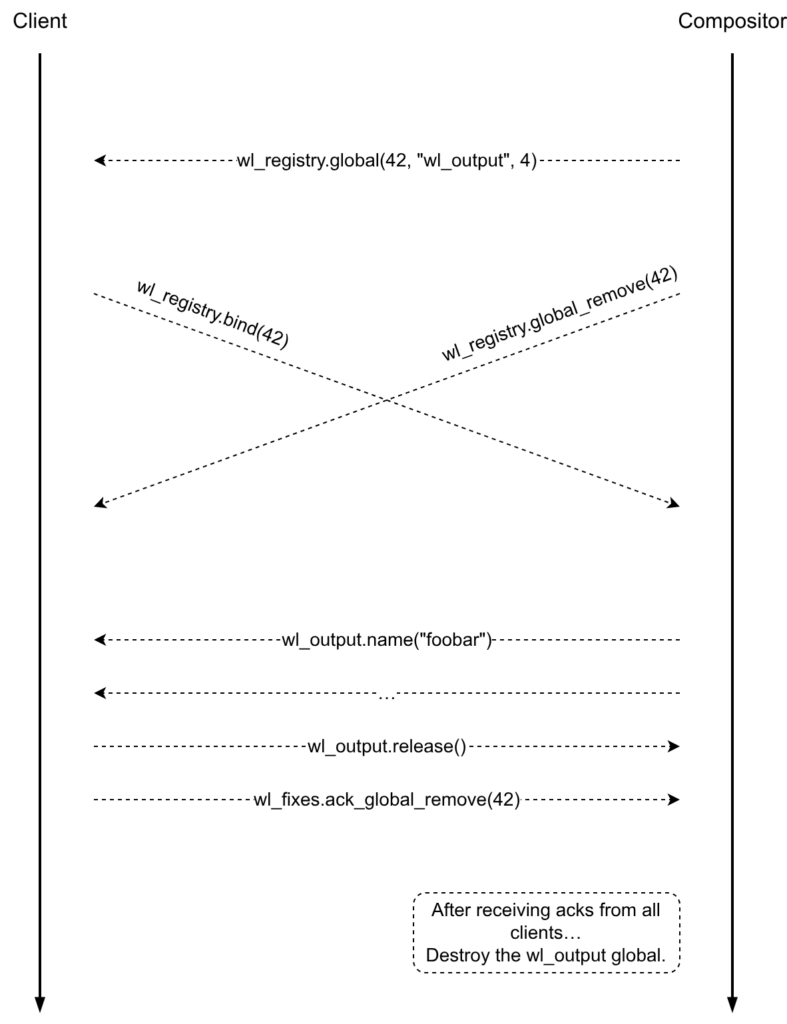
With the updated plan, the only slight change in the protocol is that the client needs to send an ack request to the compositor after receiving a wl_registry.global_remove event
After the compositor receives acks from all clients, it can finally safely destroy the global.
Note that according to this, a client must acknowledge all wl_registry.global_remove events even if it didn’t bind the corresponding global objects. Unfortunately, it also means that all clients must be well-behaving so the compositor can clean up the global data without accidentally getting any client disconnected. If a single client doesn’t ack global remove events, the compositor can start accumulating zombie globals.
Client changes
The client side changes should be fairly trivial. The only thing that a client must do is call the wl_fixes.ack_global_remove request when it receives a wl_registry.global_remove event, that’s it.
Here are some patches to add support for wl_fixes.ack_global_remove in various clients and toolkits:
libwayland-server gained a few helpers to assist with the removal of global objects. The compositor will need to implement the wl_fixes.ack_global_remove request by calling the wl_fixes_handle_ack_global_remove() function (it is provided by libwayland-server).
In order to remove a global, the compositor will need to set a “withdrawn” callback and then call the wl_global_remove() function. libwayland-server will take care of all other heavy-lifting; it will call the withdrawn callback to notify the compositor when it is safe to call the wl_global_destroy() function.
Conclusion
In hindsight, perhaps available outputs could have been announced differently, not as global objects. That being said, the wl_output did expose some flaws in the core Wayland protocol, which unfortunately, were not trivial and led to various client crashes. With the work described in this post, I hope that the Wayland session will become even more reliable and fewer applications will unexpectedly crash.
Many thanks to Julian Orth and Pekka Paalanen for suggesting ideas and code review!
Animations… Everybody loves animations. They make your desktop look more eye candy, and they also help with guiding or drawing the user’s attention towards certain elements on the screen, for example a new window or a popup or a button, etc.
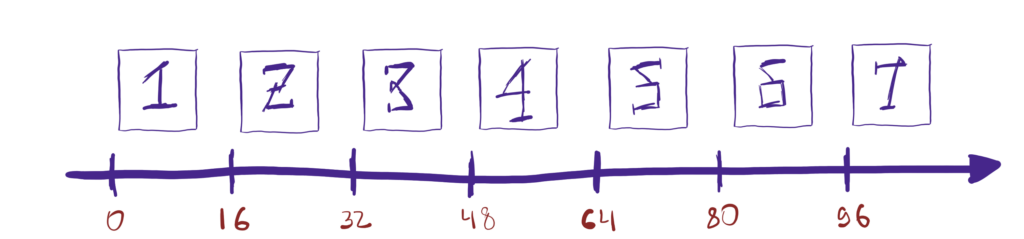
An animation is a just quick series of images to simulate the movement of an object on the screen. For example, consider a basic animation that only lists digits
A digits animation.
Animation frames.
As you can see, it’s just a sequence of individual digit images that are presented quick enough.
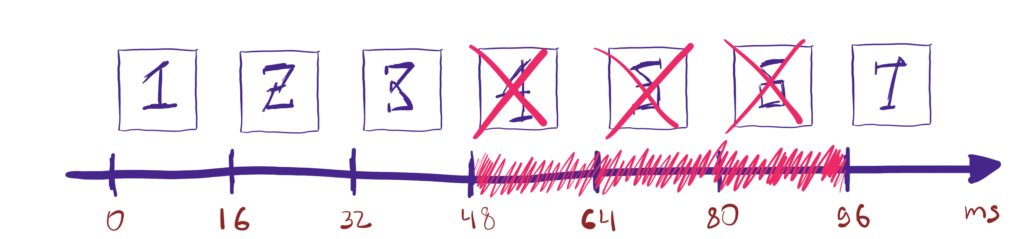
The animation frames have to presented at a steady pace to maintain the smooth feeling. If one or two frames are late, a frame drop can occur, which the user will likely notice. There are various reasons why a frame may not be presented on time. One reason might be that the app has been busy doing something else, for example loading a big file from the disk. However, there can also be reasons that are not exactly under the direct influence of the app, for example the operating system scheduler may prioritize scheduling other tasks or perhaps the memory scheduler has decided that it needs to do some of its things, etc. An animation with a frame drop may look as follows
Frames 4, 5, and 6 have been dropped.
If a frame cannot be painted on time, we are in a sticky situation no matter how you look at it. The animation won’t look as smooth as it could.
That being said, it is also worth mentioning how some apps (and compositors) drive animations. A lot of them advance animations simply by the amount of time that has passed since the last frame. In pseudo-code, it looks as follows:
The biggest drawback of this approach is that it can introduce discontinuities to the motion of an object. For example
Frame drop analysis.
If the app becomes busy for about 48 milliseconds after painting the frame 3, the delta interval will be 48 the next time a frame will be painted, which will effectively advance the animation to frame 7. Technically, this is not the wrong behavior. It does make sense if you look purely at the math. From the human eyes point of view though, the fact that there is a discontinuity in the animation now is far from ideal.
Luckily, there is a simple workaround. If we know the refresh rate of the monitor, we could estimate the maximum allowed delta interval for a single frame (for example, for a 60Hz monitor, it will be 16.6ms) and limit the animation delta time by it. It won’t make animations butter smooth but it will reduce discontinuous jumps in the animation.
Animation with smoothed delta intervals.
In comparison to the aforementioned described method to advance animations, with the proposed method, animations will advance as follows
Animation frames with smoothed/capped delta intervals.
As you can see, even though there was a frame jitter, the frames 4, 5, and 6 have not been dropped. Obviously, this is not a silver bullet solution. The final motion may still look “wonky” depending on the duration of the frame jitter but even with that being said, the advantages are still worth it. In pseudo-code, it will look as follows
The animation delta interval throttling will be implemented in the next release of Plasma. Note that this will only affect compositor-side animations, for example the ones that are played when a window is opened or closed. It will not affect animations that are played inside applications, the compositor has little actual influence on those.
In my testing, both on my desktop and a less powerful laptop, I noticed slight improvements when opening new windows, animations feel a little bit more smoother especially on the laptop. That being said, please don’t take it as me saying that animations will be perfectly smooth. No, if a frame jitter occurs, we’re in a pretty ugly situation and these changes are mostly about hardening kwin so the animations look less choppy.
Aurorae is a decoration engine that allows you easily using third party decoration themes from KDE Store.
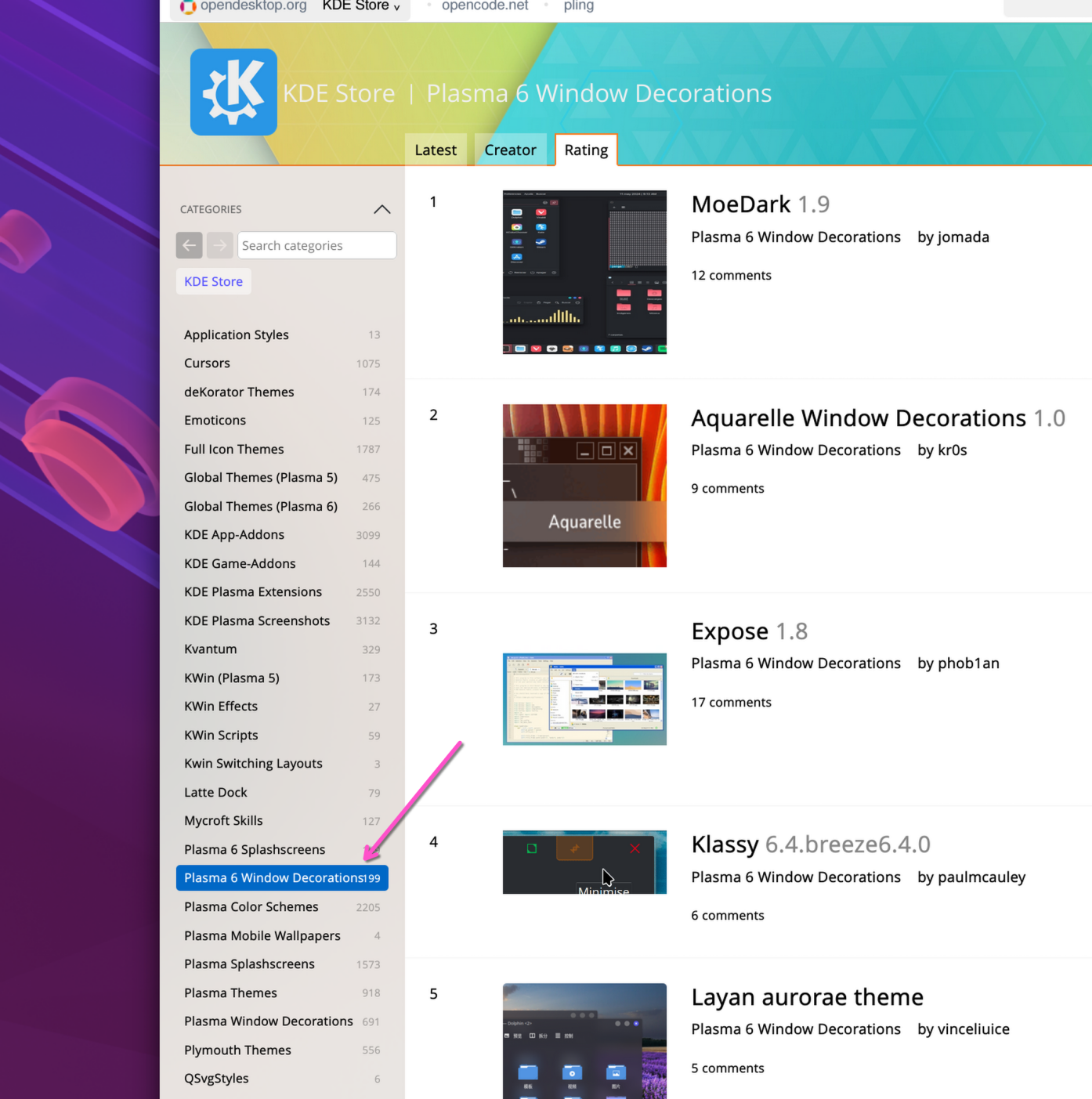
Aurorae decoration themes at KDE Store (although there are some decoration themes that don’t use Aurorae, e.g. Klassy, but a good chunk of themes found in the Plasma 6 Window Decorations category still use it)
It’s been around for quite a while and it has a plenty long history. However, in the recent years, it has been somewhat neglected. The UI trends changed, e.g. rounded corners are all the rage now, but there has been no changes in Aurorae to allow theme creators to follow those trends more easily. There are also performance issues. In comparison to the default Breeze decoration theme, it performs quite poorly, unfortunately.
What is Aurorae anyway?
In Plasma, we have a C++ library that’s used to implement window decorations called KDecoration. Both Breeze and Aurorae use KDecoration, but the main difference between the two is that the former directly implements a window decoration that follows Breeze style, while the latter is just a very themeable window decoration.
Aurorae supports both QML and SVG themes. With a QML theme, you need to write some QML code to define how the window decoration should look and behave. With an SVG theme, you need to provide a bunch of SVG files that specify how the window frame and various buttons look. Under the hood, SVG themes are effectively built as QML themes.
QML is pretty cool because with a few lines of code, you can get something that works and looks very decent. But for our usecase, it’s also a heavy tool, and due to the way how QtQuick works, it’s very challenging to have proper fractional scaling support. To be fair, normal applications that use QtQuick are mostly fine, it’s just that we have a pretty unique usecase where we need full control where every individual pixel gets painted.
Aurorae V2
Recently, I started a rewrite of Aurorae with a few goals in mind. The first goal is to improve performance so KWin doesn’t struggle when you resize a window (just to be clear, no, this doesn’t mean that there are performance issues in QtQuick. The way QML decorations are rendered is inefficient. We render a QtQuick scene in an offscreen texture, then download its contents, and then upload its contents in another texture. These roundtrips kill performance, and they are necessary because of KDecoration API constraints). The second goal is to open up the road for fractional scaling support improvements, like fixing misaligned window border edges or gaps between the decoration and the window contents. The third goal is to prepare the foundation for future improvements and to provide more tools so artists can create themes that reflect “modern” stylistic tendencies.
In this rewrite, raw KDecoration and KSvg APIs are used. This makes aurorae decorations quite lightweight and it significantly improves performance. Some fractional scaling issues have already been fixed, while others still need more work. Window decorations are rendered on the CPU side. While, yes, it will be nice to have everything done on the GPU side, doing things on the CPU side is also not that of a big bottleneck right now. In the future, we may follow up on doing more things on the GPU, but for now, it is not high priority.
The main focus has been on improving performance issues and preserving compatibility with the previous implementation of SVG decoration themes so decorations look more or less the same way. There may be some (unintentional) differences, but they should be very minimal.
What about QML decoration themes then? The main idea behind them is brilliant, but after so many years, there are not that many window decoration themes that use QML. In either case, the original (V1) and rewritten (V2) aurorae engines live side-by-side, but the future of V1 is unclear. QML and SVG decoration themes will use V1 and V2, respectively.
Future plans
At the moment, the goal is to continue polishing and optimizing V2. There are certain limits how far we can push things due to the theme format. Some parts of the theme force us to do some things, which ideally we shouldn’t do.
It’s highly likely (not saying this for sure though!) that there will be a V3, which is going to address some theme limitations and add support for new features, for example rounding bottom window corners or outlines.
If you’re a decoration theme creator and would like to see some particular feature in Aurorae, feel free to reach out to me (@zzag) on Matrix (e.g. in #kwin) or file a feature request at https://bugs.kde.org (product: kwin; component: aurorae).
Dark mode has been available in Plasma for quite a while now but the next release explores new areas where it can be taken one step further, beginning from some behind the scenes infrastructure to more user facing features such as dynamic wallpapers and automatic day/night global theme switching.
My journey to improving dark mode capabilities started at the recent Plasma Sprint. A while ago, I developed a wallpaper plugin that’s capable of synchronizing images to the position of the Sun, which I wanted to upstream but one of the biggest issues was the sheer size of the project. It supports a bunch of modes, it requires special tooling, and the wallpaper format is too cumbersome for upstream (although it’s amazing for 5K or 8K images!). So, I decided to make a pitch for adding one of the modes available in that plugin to other Plasma developers, which should be very easy to integrate with the existing infrastructure in Plasma. The idea was well-received and it led to a discussion about other related things, like better integration of geolocation services in Plasma, etc.
Plasma Sprint 2025
Day/night wallpapers
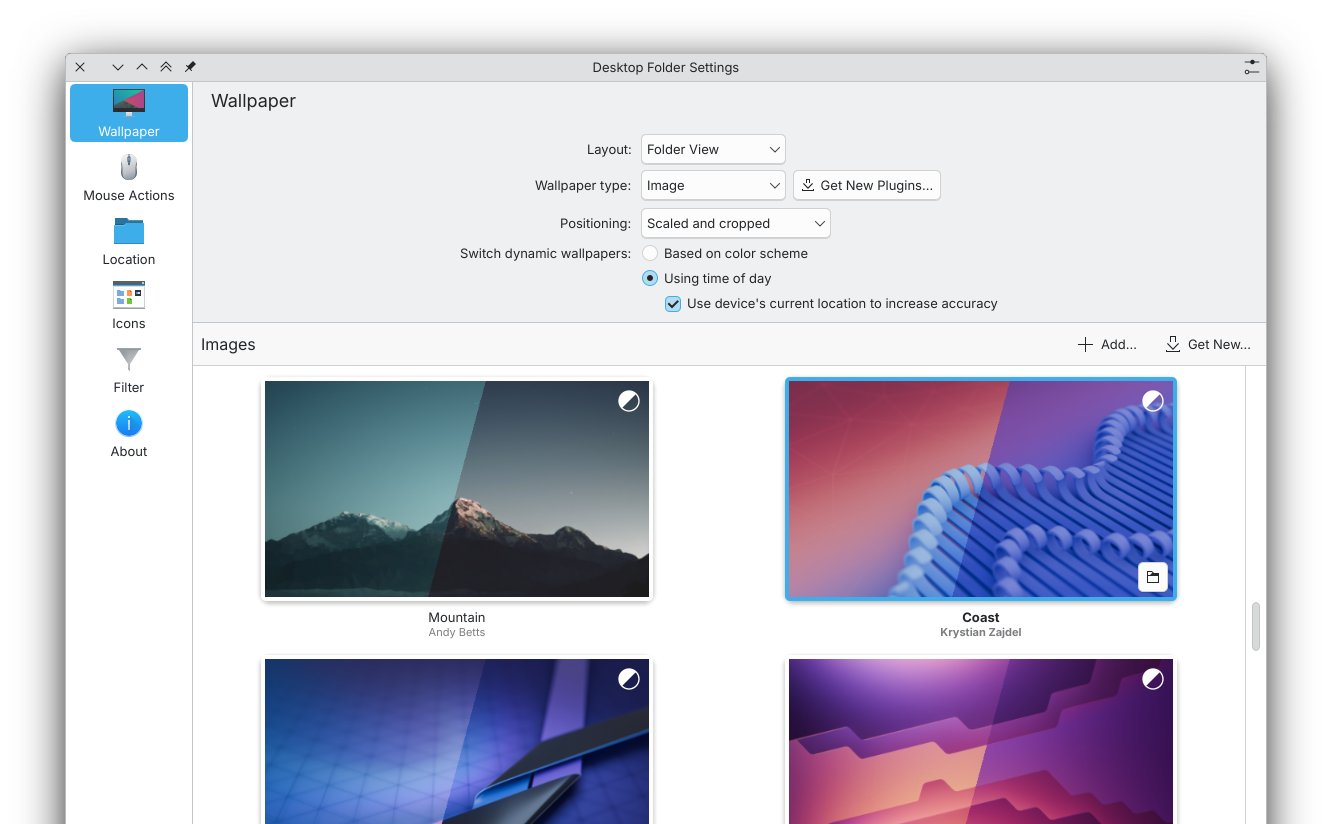
Some wallpaper packages can contain light and dark images. Currently, the light image will be used with a light color scheme, and the dark image will be used with a dark color scheme. The main idea behind the new day/night dynamic wallpapers was to exploit this design of the wallpaper packages: switch between light and dark images depending on the elevation of the Sun rather than the color scheme.
New day/night mode
The plasma5-wallpapers-dynamic served as the basis for the new dynamic wallpaper mode in Plasma. It works exactly like we want. If geolocation data is available, use it to compute the position of the Sun. The daylight duration varies depending on your location throughout the year; by taking the geolocation into account, the dynamic wallpapers can closely match the dark/light cycle. If the geolocation is unknown, fall back to some pre-configured morning and evening times.
From functional point of view, it doesn’t have any purpose, but it’s a lovely touch that helps you to personalize your computer.
While on this, we also looked into optimizing the wallpaper configuration dialog. Specifically, fixing GridView in QtQuick so it is possible to reuse wallpaper preview items for smoother scrolling and re-working the wallpaper preview generation process for better performance and to make it less error prone.
How to create a day/night wallpaper
A day/night wallpaper is a regular wallpaper package but with light and dark images, Plasma does the rest to figure out what images should be displayed.
For example, imagine that you want to create a wallpaper with a lake. Then the wallpaper would look something like this
The Lake folder contains two things: a contents folder with images and a metadata.json file. The metadata.json file provides extra information about the wallpaper, e.g. the author, etc.
The Id specifies the unique id of the wallpaper, the Name specifies the human readable name of the wallpaper. The metadata may also contain an X-KDE-CrossFade key, this is used to enable or disable long cross-fade. For example, if the transition from day to night lasts 30 minutes, then Plasma will slowly cross-fade from the light to the dark image for 30 minutes. Such a long cross-fade transition can be undesired if the images are too distinct.
images and images_dark folders contain light and dark images, respectively. Note that image file names must match the image resolution, i.e. 5120x2880.png instead of light.png, etc.
The wallpaper should be installed in /usr/share/wallpapers or ~/.local/share/wallpapers.
knighttime(d)
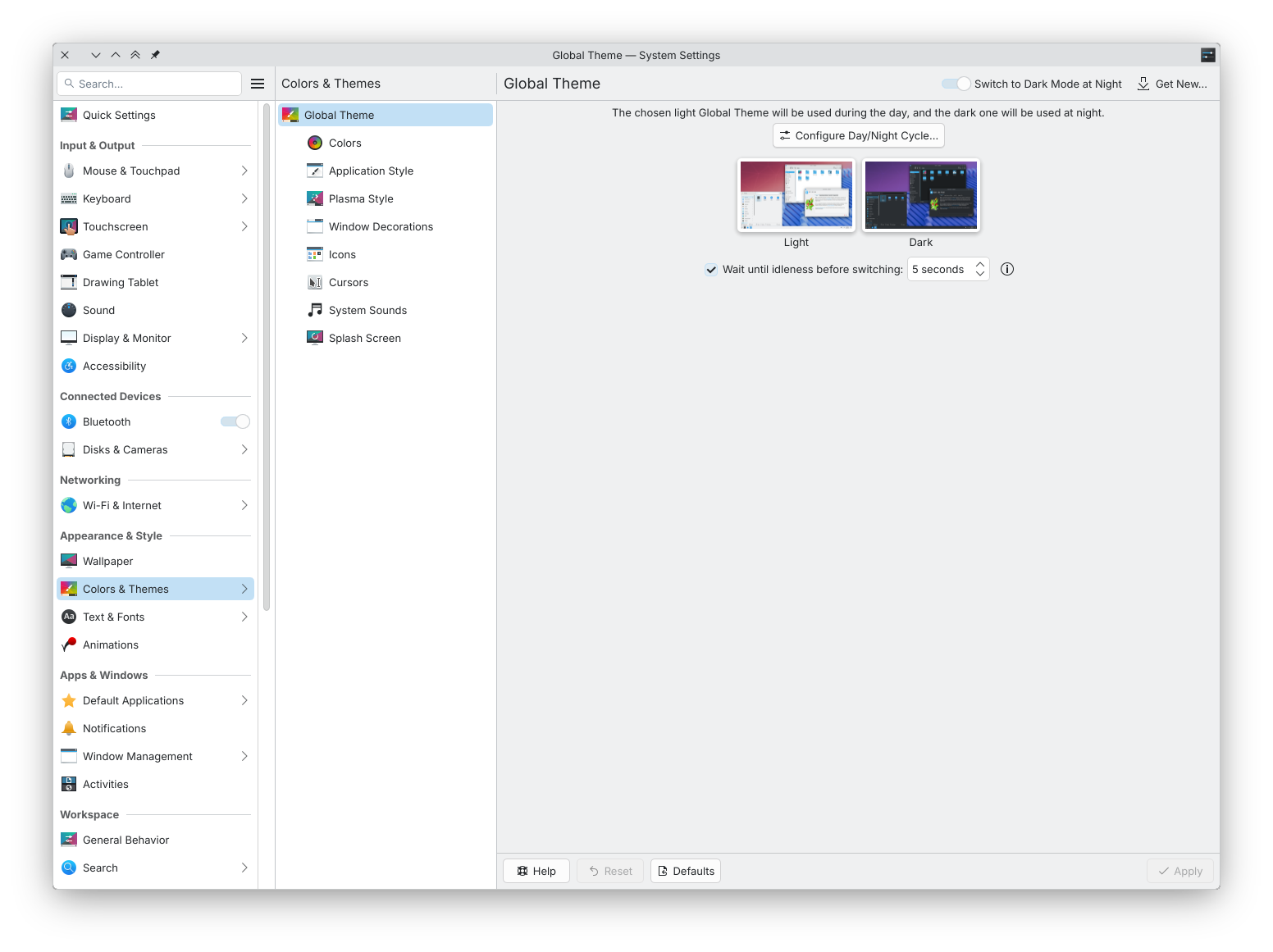
In addition to day/night wallpapers, it would also be nice if more things could be more dynamic. For example, switching the global theme at night. However, this creates a bit of a problem. If you want to configure the times when wallpapers or themes need to be changed, you will need to set settings for every feature individually, which is not great.
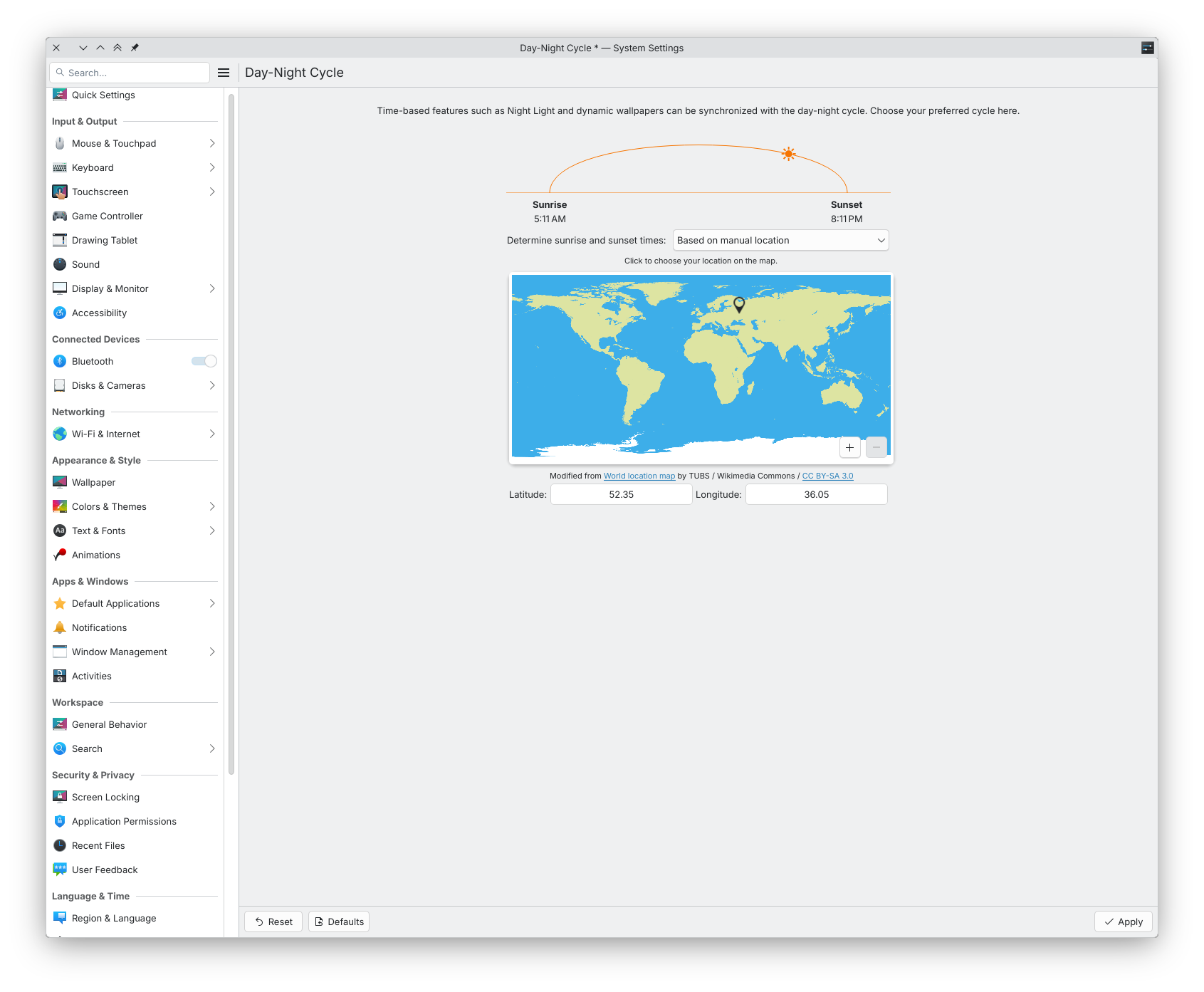
To solve that problem, a new desktop component was introduced that orchestrates when morning and evening transitions occurs – KNightTime. It’s a super duper tiny project with a client library and a daemon (knighttimed) that provides the schedule for day/night cycle transitions.
Since all features that synchronize to the day/night cycle subscribe to KNightTime, you only need to configure it to use specific morning and evening times. Night Light, day/night wallpapers and so on will be all synchronized.
knighttimed runs in background and it is started on demand, so in most cases, you don’t even need to worry about its existence.
Day/night themes
Besides the wallpaper, one can also switch between light and dark global themes depending on time of day.
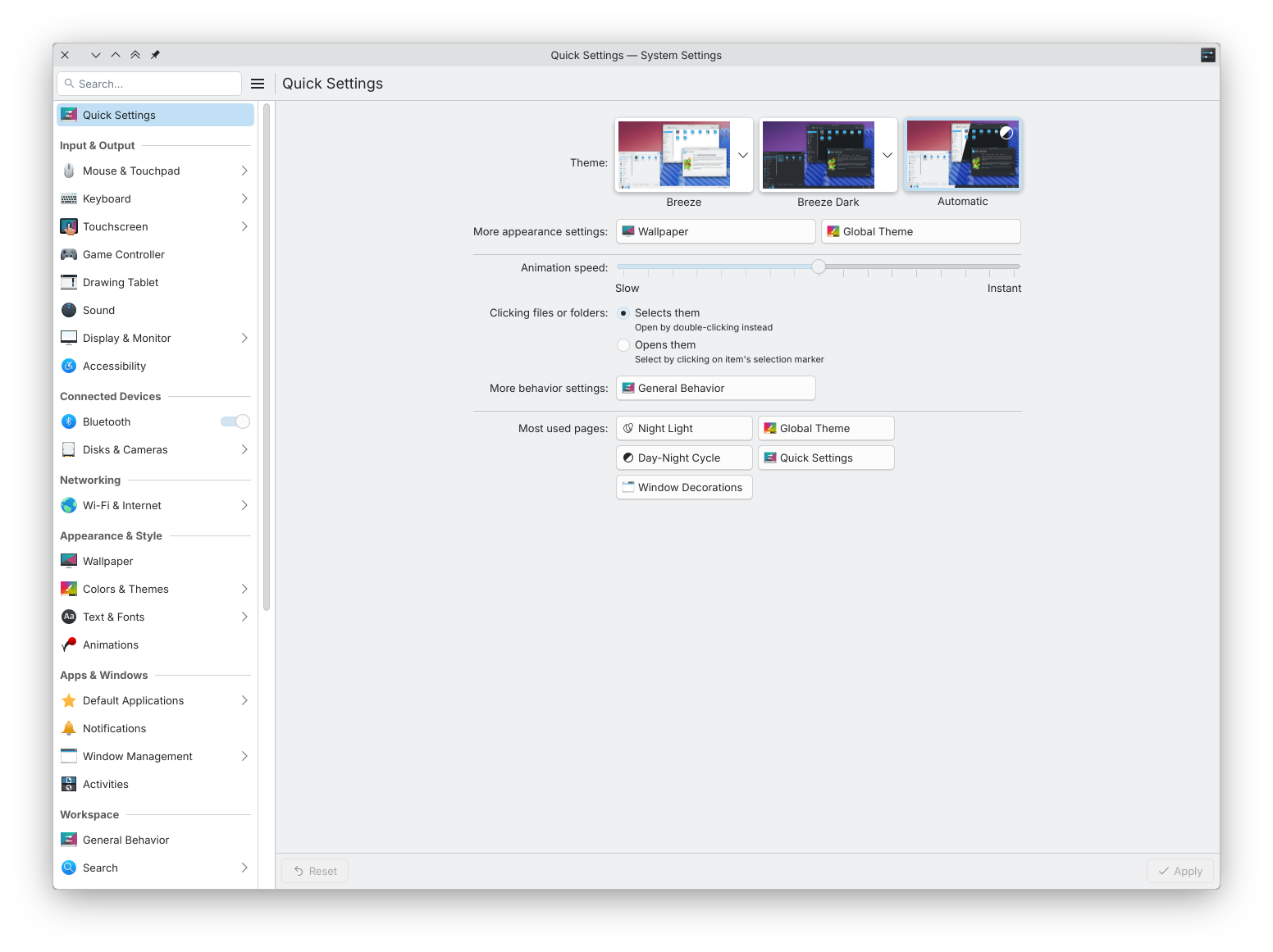
Perhaps the hardest part about this was figuring out how to retrofit our system settings to accommodate for this new mode rather than actually implementing the logic that changes the active theme. Many thanks to Felix Ernst and Nate Graham for providing mock-ups and feedback about the UI.
Global theme optionsLanding page
It is worth noting that Plasma will switch between the themes only if the computer has been idle for 5 seconds. The main reason behind this is to avoid interruptions while actively using the computer. In case you don’t like it, you can turn it off in system settings or increase the default idle interval if you think it’s too low for your needs.
With the automatic mode, the global theme switching code is going to be stress-tested quite a bit, so we’ve also started (and continue) looking into various paper cut issues regarding theme switching, e.g. some buttons not adapting to the new color scheme correctly, etc.
Future improvements
There are other things that can be synchronized to the day-night cycle, for example screen brightness. Although, there is nothing clear on the radar yet.
Conclusion
The next release is going to feature a few dark mode improvements. Some are pretty technical, some are very user facing. In either case, I hope that things like this will help to make Plasma users happier and make Plasma stand out more among other desktop environments.
One of the biggest behind-the-scenes changes in the upcoming Plasma 6.4 release is the split of kwin_x11 and kwin_wayland codebases. With this blog post, I would like to delve in what led us to making such a decision and what it means for the future of kwin_x11.
Background
KWin started as an X11 window manager almost two and a half decades ago. Over the course of the years, it transformed drastically. It gained support for compositing on X, and it became a Wayland compositor.
Sharing the same codebase was critical in the early days of kwin_wayland. We already had working window management abstractions, which had been tested for many years, so we could reuse them on Wayland instead of writing new from scratch. Also, if kwin_x11 gained a new feature, then kwin_wayland would likely gain it for free too.
As time went by, kwin_wayland outgrew kwin_x11. They still shared code but they became quite distinct projects with different mental models how things operate, e.g. how pixels get on the screen or how input works. It also didn’t help that many Plasma developers jumped the X11 ship and turned to the Wayland side as part of the “eating your own dog food” practice, which eventually led to the feature freeze in KWin/X11 back in 2018 due to the lack of sufficient testing and various breakages.
Some time around 2020, we started taking a more bold and aggressive approach to Wayland session development because we saw that Plasma Wayland was trailing behind other desktop environments and something had to be changed in order to catch up. Such a policy produced great results, and Plasma is now one of the leading Wayland desktop environments. Unfortunately, it also greatly contributed to the number of regressions in the X11 session.
Another issue was that there were some features that we couldn’t make work as expected on Wayland so we had to drop them for everyone, which understandably made X11 users unhappy.
Goals
A few years ago, we started contemplating the idea of splitting the X11 and Wayland codebases because of the growing list of regressions affecting the X11 session, and architecture restrictions imposed on KWin/Wayland by the way KWin/X11 works.
That would allows us to keep KWin/X11 working as is without it breaking too often and freely change KWin/Wayland in ways that we think are best suited to make the Plasma Wayland session even better. Of course, it is not a silver bullet solution: we replace one problem with another problem (mainly related to maintenance and ensuring interface compatibility between two projects).
Details
After various discussions online and at Akademy and also seeing (impressive) Plasma Wayland usage statistics, we decided that it’s the right time to do such a split. The main kwin repository is going to host KWin/Wayland, while the kwin-x11 repository is going to host KWin/X11.
KWin/X11 and KWin/Wayland are co-installable so users can freely switch between the X11 and Wayland sessions back and forth and also make sure that updating to 6.4 is not a big hassle for distributions. You’ll be able to have only KWin/X11 or only KWin/Wayland on your computer, or both.
The codebase split doesn’t affect Xwayland support in KWin/Wayland. In other words, X11 applications will continue running on Plasma Wayland.
Extensions
Like any other Plasma component, KWin’s functionality can be extended using plugins. There’s good and bad news. The good news is that extensions written in JavaScript and QML (for example, fancy effects that are available at the KDE Store) will continue working both with kwin_x11 and kwin_wayland as expected, so extension developers don’t need to do anything about it. The bad news is that C++ extensions should be specifically targeted for kwin_x11 and kwin_wayland because neither provides API and ABI compatibility guarantees for its C++ API.
As Wayland progress moves forward, it is likely that the scripting API of KWin/Wayland will be further extended.
Future of KWin/X11
KWin/X11 will be still maintained for the foreseeable future. But that maintenance work will boil down to fixing build errors, adapting to new KDE Frameworks and Plasma APIs, and backporting window-related fixes from KWin/Wayland. There are no plans to drop KWin/X11 in the Plasma 6 lifecycle, although it’s highly possible that it will happen in Plasma 7.
KWin/X11 won’t receive new features anymore; until recently, it received new features that had been developed against KWin/Wayland passively (because both lived in the same repository). However, it might be actually a good thing because the X11 session doesn’t receive that much testing nowadays.
Just a quick update: Recently, you might have heard that GTK 4 added support for the cursor-shape-v1 protocol on Wayland. The main advantage of the cursor-shape-v1 protocol is that it ensures consistent cursor look between apps. In Plasma, additional perks come with it, for example the cursor can look more crisp with fractional scale factors because SVG cursors are used. We (KDE) took a shot at backporting the cursor shape protocol support to the GTK 3 branch and, as of this moment, it’s already merged 🎉. This means that you should experience fewer cursor issues in applications running on Wayland that still use GTK 3, mainly Firefox.
I would like to express many thanks to Max Qian for starting the work on adding support for the cursor-shape-v1 protocol, and Matthias Clasen for pushing it over the finish line and reviewing our backport MR.
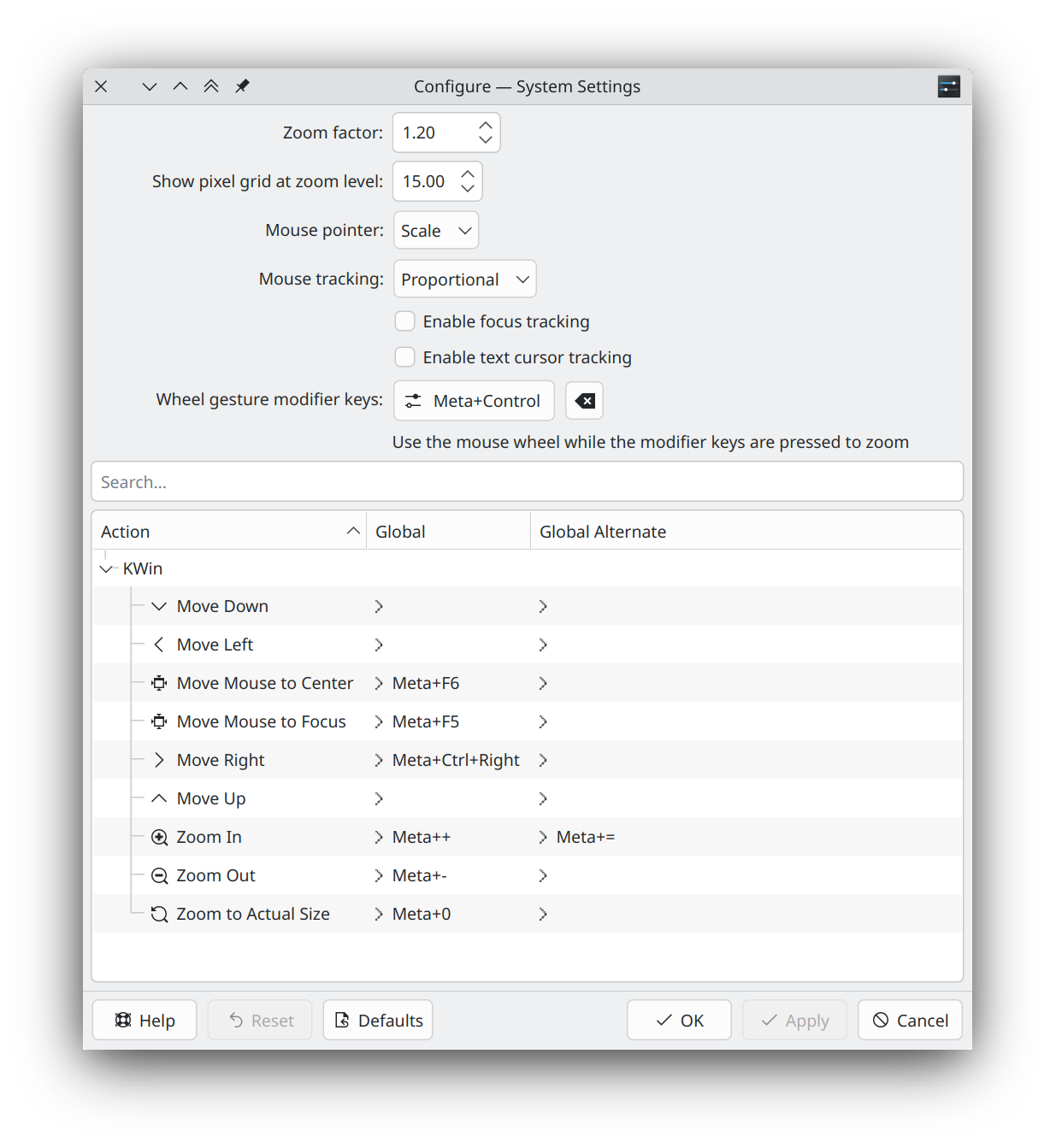
Screen magnification is an accessibility feature that enlarges the screen to make text, images, and other user interface components easier to see or read. It is not something that requires constant developer attention, however, in Plasma 6.3, the zoom plugin received some improvements that I’d like to go over quickly.
Pixel grid
Arguably, it will be too hard to read text if the screen is “too” zoomed in. There are several ways how this case can be handled. For example, the magnification factor can be capped (e.g. to x8 or x10), or do nothing and just display blurry upscaled screen contents… or display something else.
With the old behavior, the zoom plugin used not to do anything special when the magnification factor reaches a high value, but with the new behavior, it is going to display the individual pixels on the screen. This can be very useful to developers, designers, etc.
System settings
In addition to the new pixel grid mode, the system settings for the zoom plugin received minor polishing to look more consistent with other config modules.
Future improvements
Keyboard shortcuts are not the only way how the zoom plugin can be triggered. For example, it can be also triggered by pressing Meta and Control keys and scrolling the mouse wheel to zoom. However, it is not exposed anywhere in the user interface and some people may prefer zooming with just the Meta key pressed. In order to address the discoverability issue of the mouse wheel gesture and allow using a different combination of modifier keys, there is already a patch to add the corresponding system setting, but it’s 6.4 material. It would be also nice to move screen magnifier settings from the desktop effects config module to the accessibility config module.
Last but not least, the zoom effect currently uses the bi-linear magnification filter, which produces okay-ish visual results, but it’s worth looking for alternative upscaling algorithms that handle edges better so zoomed in text looks less blurry.
One of the quickest ways to determine whether particular application runs using Xwayland is to resize one of its windows and see how it behaves, for example
While it can be handy for the debugging purposes, overall, it makes the Plasma Wayland session look less polished. So, one of the goals for 6.3 was to fix this visual glitch.
This article will provide some background behind what caused the glitch and how we addressed it. Just in case, here’s the same application, which was shown in a screen cast above, but with the corresponding resizing fixes in:
X11 frame synchronization protocol(s)
On X11, all window changes typically take place immediately, including resizing. This can lead to some issues. For example, if a window is resized, it can take a while until the application repaints the window with the new size. What if the compositing manager decides to compose the screen in meanwhile? You’re likely going to see some sort of visual glitches, e.g. the window contents getting cropped or seeing parts of the window that have not been repainted yet.
In order to address this issue, there exists an X11 protocol to synchronize window repaints during interactive resize. An application/client wishing to participate in this protocol needs to list _NET_WM_SYNC_REQUEST in the WM_PROTOCOLS property of the client window and also set the XID of the XSync counter in the _NET_WM_SYNC_REQUEST_COUNTER property. When the WM wants to resize the window, the following will happen:
The window manager sends a _NET_WM_SYNC_REQUEST client message containing a serial that the client will need to put in the XSync counter after processing a ConfigureNotify event that will be generated after the window is resized. The compositing manager and the window manager will block window updates until the XSync request acknowledgement is received;
The WM resizes the client window, for example by calling the xcb_configure_window() function;
The client would then repaint the window with the new size and update the XSync counter with the serial that it had received in step 1;
The window manager and the compositing manager unblock window updates after receiving receiving the XSync request acknowledgement. For example, now, the window can be repainted by the compositing manager and there shouldn’t be glitches as long as the client behaves well.
Note that the window manager and the compositing manager are often the same. For example, both KWin and Mutter are compositing managers and window managers.
The frame synchronization protocol described above is called basic frame synchronization protocol. There is also an extended frame synchronization protocol, but it is not standardized and it is implemented only by a few compositing managers.
_NET_WM_SYNC_REQUEST and Xwayland
KWin supports the basic frame synchronization protocol, so there should be no visual glitches when resizing X11 windows in the Plasma Wayland session, right? At quick glance, yes, but we forget about the most important detail: Wayland compositors don’t use XCompositeNameWindowPixmap() or xcb_composite_name_window_pixmap() to grab the contents of X11 windows, instead they rely on Xwayland attaching graphics buffers to wl_surface objects, so there is no strict order between the Wayland compositor receiving an XSync request acknowledgement and graphics buffers for the new window size.
In order to help better understand the issue, let’s consider a concrete example. Assume that a window with geometry 0,0 100x100 is being resized by dragging its left edge. If the left edge is dragged 10px to the right, the following will happen:
A _NET_WM_SYNC_REQUEST client message will be sent to the client containing the XSync counter serial that must be set after processing the ConfigureNotify event that will be generated after the Wayland compositor calls xcb_configure_window() with the new window size;
The Wayland compositor calls xcb_configure_window() to actually resize the window;
The client receives the sync request client message and the ConfigureNotify event, repaints the window, and acknowledges the sync request;
The Wayland compositor receives the sync request acknowledgement and updates the window position to 10,0.
But here is the problem, when the window position is updated to 10,0, it’s not guaranteed that the wl_surface associated with the X11 window has a buffer with the new window size, i.e. 90x100. It can take a while until Xwayland commits a graphics buffer with the right size. In meanwhile, the compositor could compose the next frame with the new window position, i.e. 10,0, but old surface size, i.e. 100x100. It would look as if the right window edge sticks out of the window decoration. After Xwayland attaches a buffer with the right size, the right window edge will correct itself.
So, ideally, the Wayland compositor should update the window position after receiving the XSync request acknowledgement and Xwayland attaching a new graphics buffer to the wl_surface.
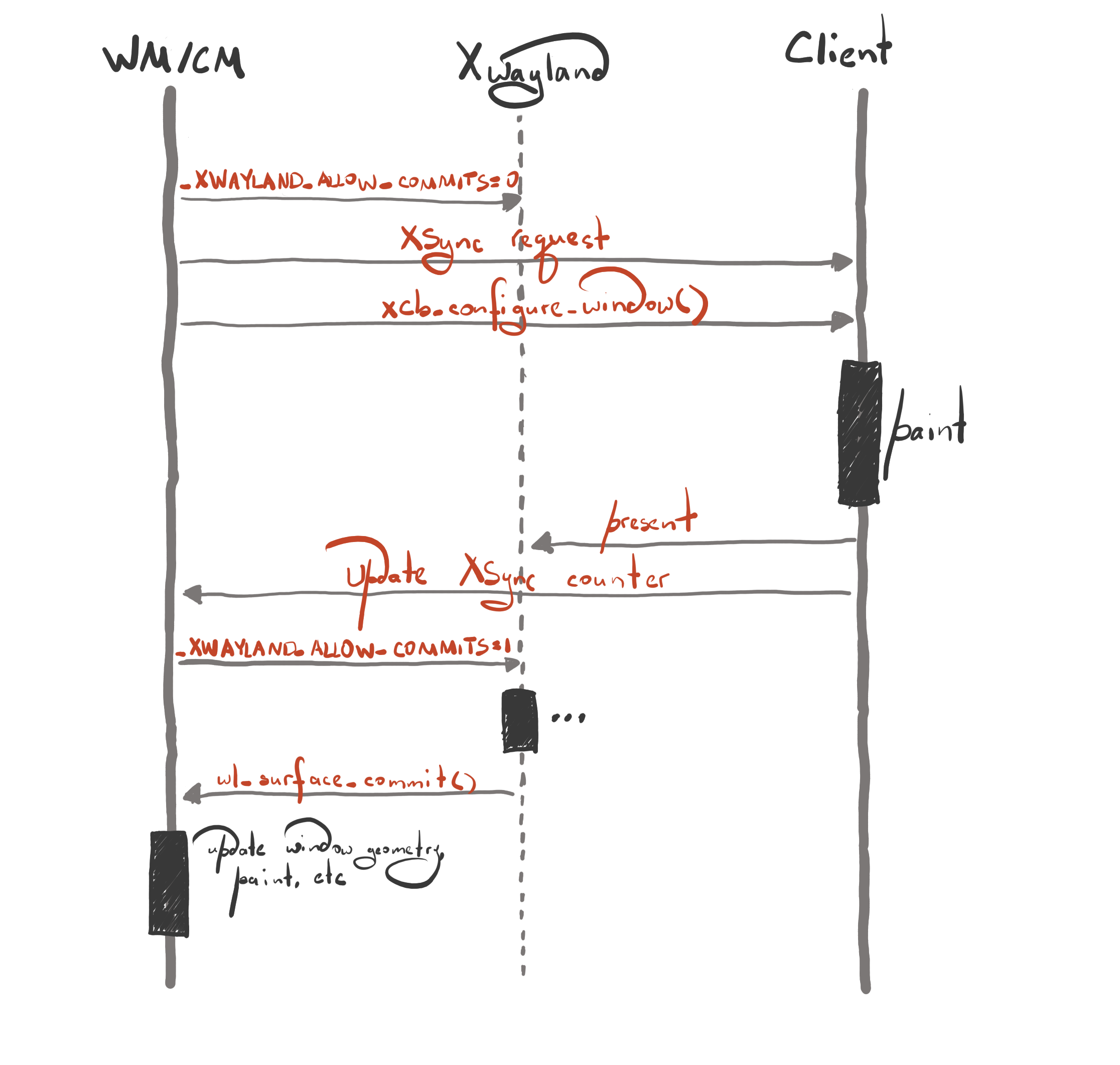
With that in mind, the frame synchronization procedure looks as follows:
The compositor blocks wl_surface commits by setting the _XWAYLAND_ALLOW_COMMITS property to 0 for the toplevel X11 window. This is needed to ensure the consistent order between XSync request acknowledgements and wl_surface commits. As long as the _XWAYLAND_ALLOW_COMMITS property is set to 0, Xwayland will not attempt to commit the wayland surface, for example attach a new graphics buffer after the client repaints the window;
The compositor sends a _NET_WM_SYNC_REQUEST client message as before;
The compositor resizes the client window as before;
The client repaints the window and acknowledges the XSync request as before;
After receiving the XSync acknowledgement, the compositor unblocks surface commits by setting the _XWAYLAND_ALLOW_COMMITS property to 1. Note that the window updates are still blocked, i.e. the window position is not updated yet;
After Xwayland commits the wl_surface with a new graphics buffer, the window updates are unblocked, e.g. the window position is updated.
The frame synchronization process looks more involved with Xwayland, but it is still manageable.
_NET_WM_SYNC_REQUEST support in applications
Most applications that use GTK and Qt support _NET_WM_SYNC_REQUEST, but there are applications that don’t participate in the frame synchronization protocol. If you use one of those apps, you will observe visual glitches during interactive resize.
Closing words
Frame synchronization is a difficult problem, and requires some very intricate code both on the compositor and the client side. But with the changes that we’ve made, I’m proud to say that KWin is one of the few compositors that properly handles frame synchronization for X11 windows on Wayland.
I would also like to express many thanks to the Xwayland developers (Michel Dänzer and Olivier Fourdan) for helping and assisting us with fixing the glitch.
SVG cursor themes is a new feature in Plasma 6.2, which we are really excited about. In this blog post, I would like to provide more background behind what motivated us to add support for them, what they are, and how to build them.
(Classic) cursor theme format
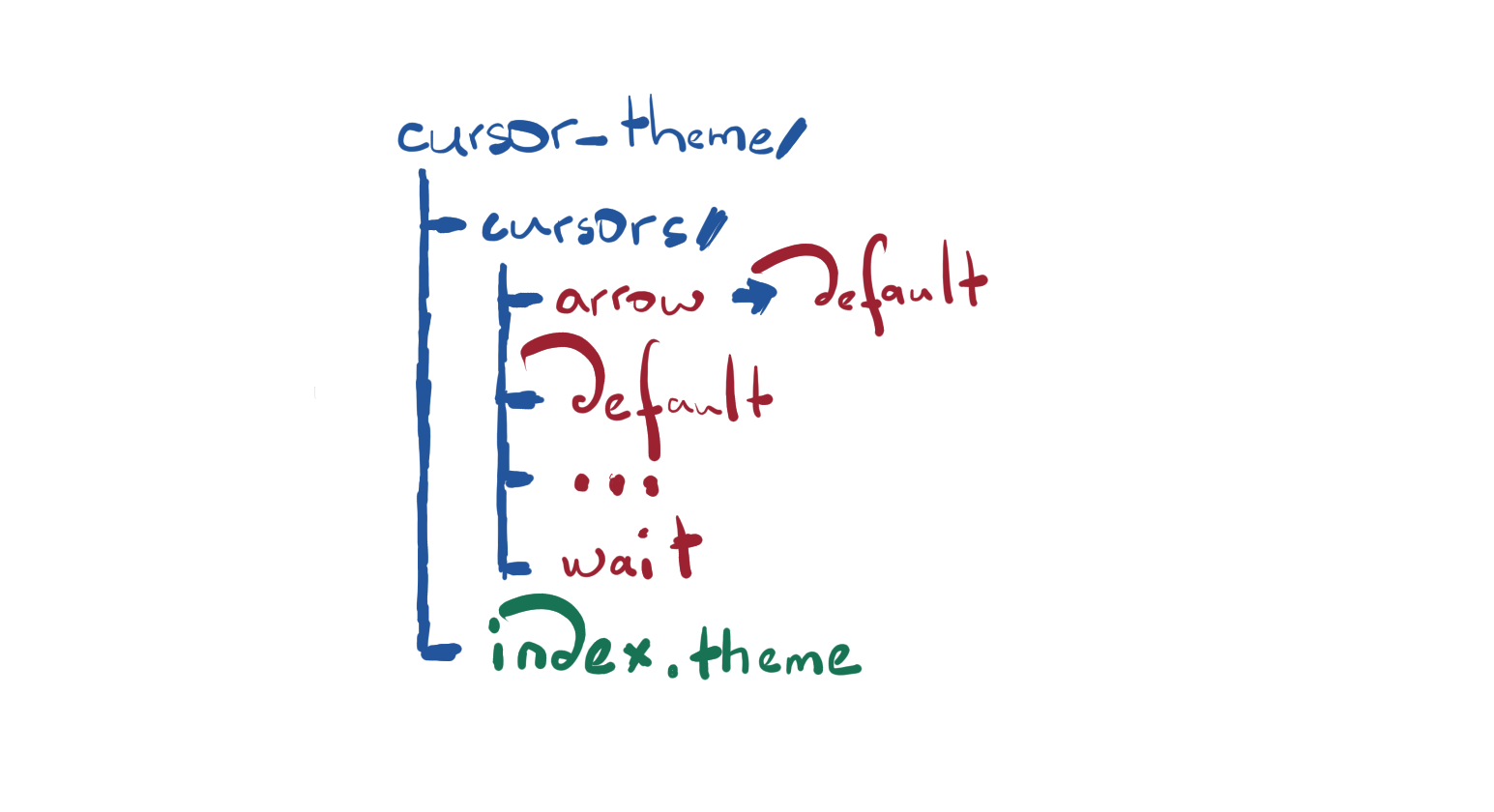
A cursor theme is a collection of images defining the contents of various cursor shapes and additional metadata (for example, the human readable name of the theme, whether the cursor theme inherits/extends another cursor theme, etc). On disk, it looks as follows
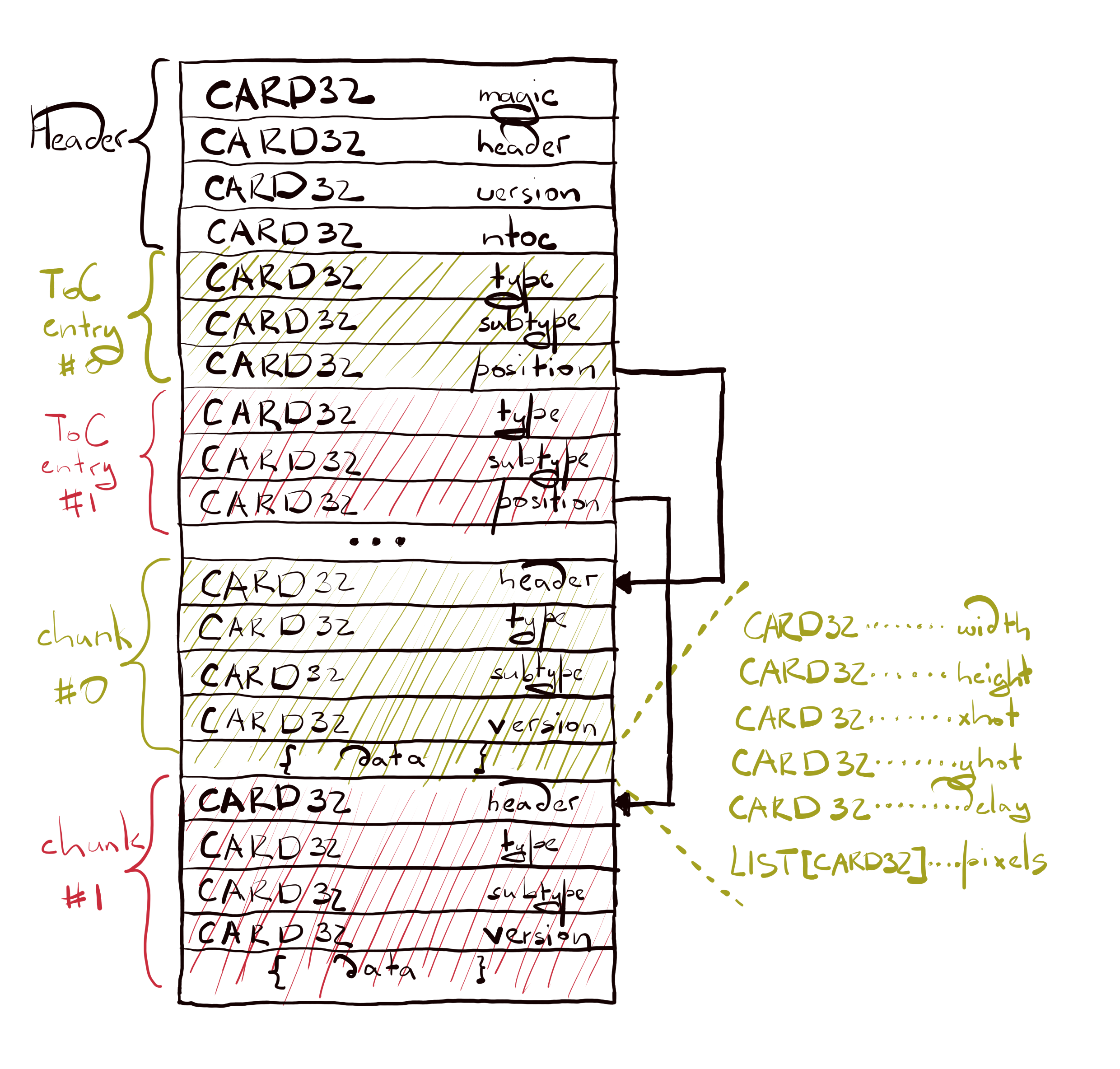
The cursors/ directory contains a list of Xcursor files and symbolic links to represent cursor shape aliases, e.g. the arrow being an alias for default. The XCursor format has been in use for a very long time now and it has a pretty simple structure
The layout of an XCursor file
An XCursor file consists of a header that includes a magic number to determine whether particular file is actually an XCursor file, the size of the header in bytes, the file version, and the number of ToC entries. Every ToC entry provides the information about the corresponding chunk, for example the chunk type and where the chunk can be found in the file. Lastly, a chunk contains some useful data. A chunk may contain image data or text data, etc.
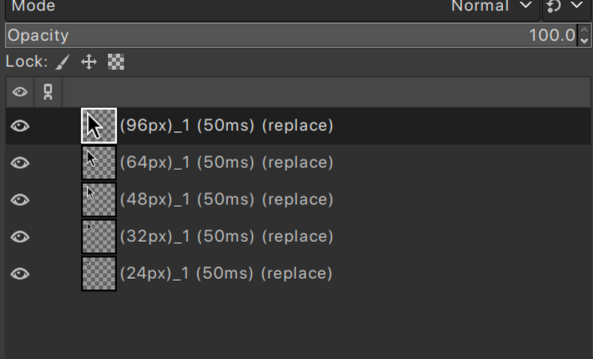
For example, here’s the image data that can be found in the “default” cursor shape file in the Adwaita cursor theme
As you can see, the Adwaita cursor theme provides the following sizes: 24, 32, 48, 64, and 96.
The index.theme files looks as follows
[Icon Theme]
Inherits=breeze_cursors
Name=Cool Cursor
Comment=That is a cool cursor theme
Cursor themes can be found in $DATADIR/icons directories. For example, /usr/share/icons or ~/.local/share/icons.
X11 vs Wayland cursors
Xcursor cursors are used both on X11 and Wayland, but the way how the cursor size is interpreted is different on the two platforms. X11 assumes that the cursor size is specified in the device pixels, while Wayland assumes that it’s in the logical pixels. Logical pixels have the same visual size across various devices, while physical pixels are specific to particular device. For example, 24 logical pixels on an output with a scale factor of 2 corresponds to 48 physical pixels.
Cursor sizes in Xcursor files are specified in the device pixels.
Another very important detail is that the XCURSOR_SIZE environment variable is treated differently by X11 and Wayland native applications. For example, if XCURSOR_SIZE is set to 24 and the output scale is 2, an X11 application would load a cursor with the size 24, but a Wayland application would effectively load a cursor with the size 48 (24 * 2) because it would see that the output is scaled so the provided cursor needs to be scaled accordingly as well.
“XCURSOR_SIZE=24 dolphin -platform xcb” (left) vs “XCURSOR_SIZE=24 dolphin -platform wayland” (right). Note that “Apply scaling themselves” has been selected in the display settings in Plasma Wayland
Limitations of Xcursor
The most painful thing about Xcursor is its lack of the proper HiDPI support. As it was said in the previous chapter, the cursor size in Xcursor files is specified in the device pixels. On X, it’s not a problem because all geometries are specified in the device pixels. It also means that if you change the scaling factor on X, you need to change the cursor size manually so the cursor is not too small. On Wayland, the cursor size is specified in the logical pixels so the compositor and the clients have to scale the cursor size in order to match the output scale. For example, if the configured cursor size is 24 and the window is on an output with a scale factor of 2, the application needs to load an Xcursor cursor with the size 48. If the cursor theme provides cursors with such a size, perfect! But what if it doesn’t? At the moment, every compositor and client applies its own policies. Some find the cursor with the closest size and use that, some find the cursor with the closest size and then scale it to match the requested size at the cost of adding some blurriness, and so on. It’s a mess. Because neither compositors nor clients can agree how to handle such a case, you could easily observe the cursor changing its size when moving between windows owned by different applications or when moving the cursor between the window and its decoration, e.g.
It’s worth noting though that this issue can be worked around by using the cursor-shape protocol because with it, the application can delegate the compositor the task of loading and displaying cursors. But the bottom line is that the Xcursor format is unsuitable for the HiDPI model that we have present on Wayland.
Another issue with the Xcursor format is that the image data is stored in an uncompressed format. It is okay if you need to provide cursors with small sizes, for example up to 72, but there are cases when you need to display a cursor at a very large size. For example, one such a case is the shake cursor accessibility feature in the Plasma Wayland session.
With the shake cursor feature enabled, the cursor will be inflated when it’s shaken. In order to operate, it needs to load the default cursor shape with a size around 250. If cursor themes provided images for such sizes, their package sizes would easily blow up beyond the 100MiB mark. That’s not good. And as a workaround, in Plasma 6.1, the shake cursor uses its own high resolution images of the Breeze cursor themes.
The XCursor format was perfectly suitable for the use cases that existed back in the late 90s and early 2000s, but things have changed over the years and its current raster nature can’t keep up with the use cases that we have now (2024). We’ve got fractional scaling, we’ve got accent colors, we’ve got features that enlarge the cursor, and so on.
SVG cursor format
First of all, let’s build a list of requirements that the svg cursor format must satisfy:
obviously, it must support the ability to define cursor contents using svg files so we can fix HiDPI issues, etc
easy porting process for existing clients and compositors
it should be easy to develop and analyze svg cursor themes. Xcursor is a binary file format, which requires a special tool to create Xcursor files, we would like to avoid that with svg cursors
last and the most important requirement is that there must be some compatibility with the existing cursor theme format. We must not be required to write a new system settings module to handle the new cursor format, and the apps that don’t support svg cursors should easily fallback to the Xcursor format.
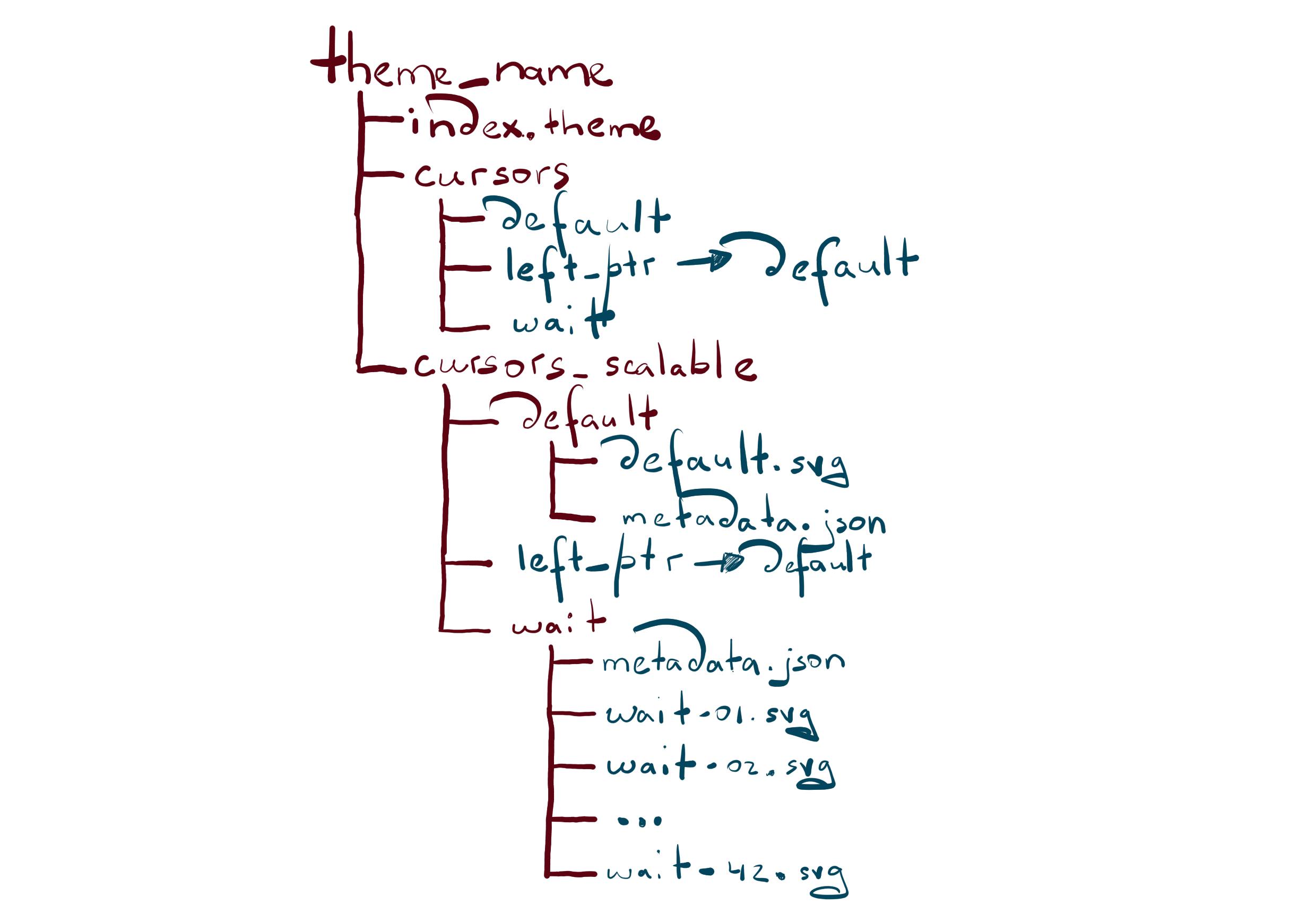
Here’s how a cursor theme providing svg cursors would look like
index.theme has the same format both for XCursor and SVG cursors. cursors/ directory contains the XCursor cursors, and cursors_scalable/ contains the SVG cursors.
In cursors_scalable/, every cursor shape must have its own directory, or if it’s an alias, then it must be a symlink. Every cursor shape directory must contain the cursor image and a metadata.json file providing the information about the cursor.
For a static cursor, the metadata.json file looks as follows
The filename property specifies the filename of the svg file. The hotspot_x and the hotspot_y properties specify the coordinates of the hot spot. The hot spot in the cursor determines the point where interaction with other elements on the screen occurs, e.g. clicks. The nominal_size property specifies the cursor size that the svg file represents. The nominal size is used to decide how much the svg image and the hotspot coordinates need to be scaled in order to get a cursor with the requested size. Note that the nominal size can’t be determined based on the <svg>‘s width and height attributes because there exist themes such as Breeze whose canvas is bigger than the represented cursor size. As an example, in the Breeze cursor theme, the canvas size is 32x32 even though the represented cursor size is 24 in order to accommodate for additional elements that can be attached to the arrow cursor, e.g. a little circle with a plus sign or a question mark.
For an animated cursor, the metadata.json file looks as follows
The only new thing is the delay property. The delay property indicates the animation delay to the next frame.
A cursor theme that ships SVG cursors is required to have XCursor cursors too. This is needed to provide fallback for legacy applications that are unaware of the cursor-shape-v1 protocol or simply too old applications that are unlikely to be changed anymore. This restriction might be lifted in the future.
It is worth mentioning that SVG supports animations natively. However, that approach was not chosen for cursor animations for two reasons: to allow caching svg render results more easily and require fewer changes in the compositors and the apps to adapt the svg cursor format.
You can find the json schema for metadata.jsonover here.
Accent colors
Since the cursor contents is specified using the SVG format, it should be possible to re-color the cursor based on the currently configured accent color. As of now, it is not implemented, but, in general, this is doable and perhaps such a feature will be added to Plasma some day.
Standardization
This cursor format is not officially standardized. We are looking forward to making it upstream, but for now, the main focus is on confirming that the new format lives up to our and cursor creator needs.
To cursor theme creators
Breeze and Breeze Light are the only two cursor themes that support SVG cursors at the moment, but we would love to see custom themes adapting them too so users experience fewer issues with fractional scaling or other features in Plasma when using their favorite 3rdparty cursor themes. We would also like to hear feedback from the cursor theme creators regarding whether it’s easy to adapt this cursor format or whether some additional features are needed. You can reach out to us at Matrix in the #kwin room https://webchat.kde.org/#/room/#kwin:kde.org or in the kwin mailing list.
Examples
If you need an example of a cursor theme that supports SVG cursors, please check the Breeze cursor theme.
Closing words
The new SVG cursor format is amazing. Please try it!